

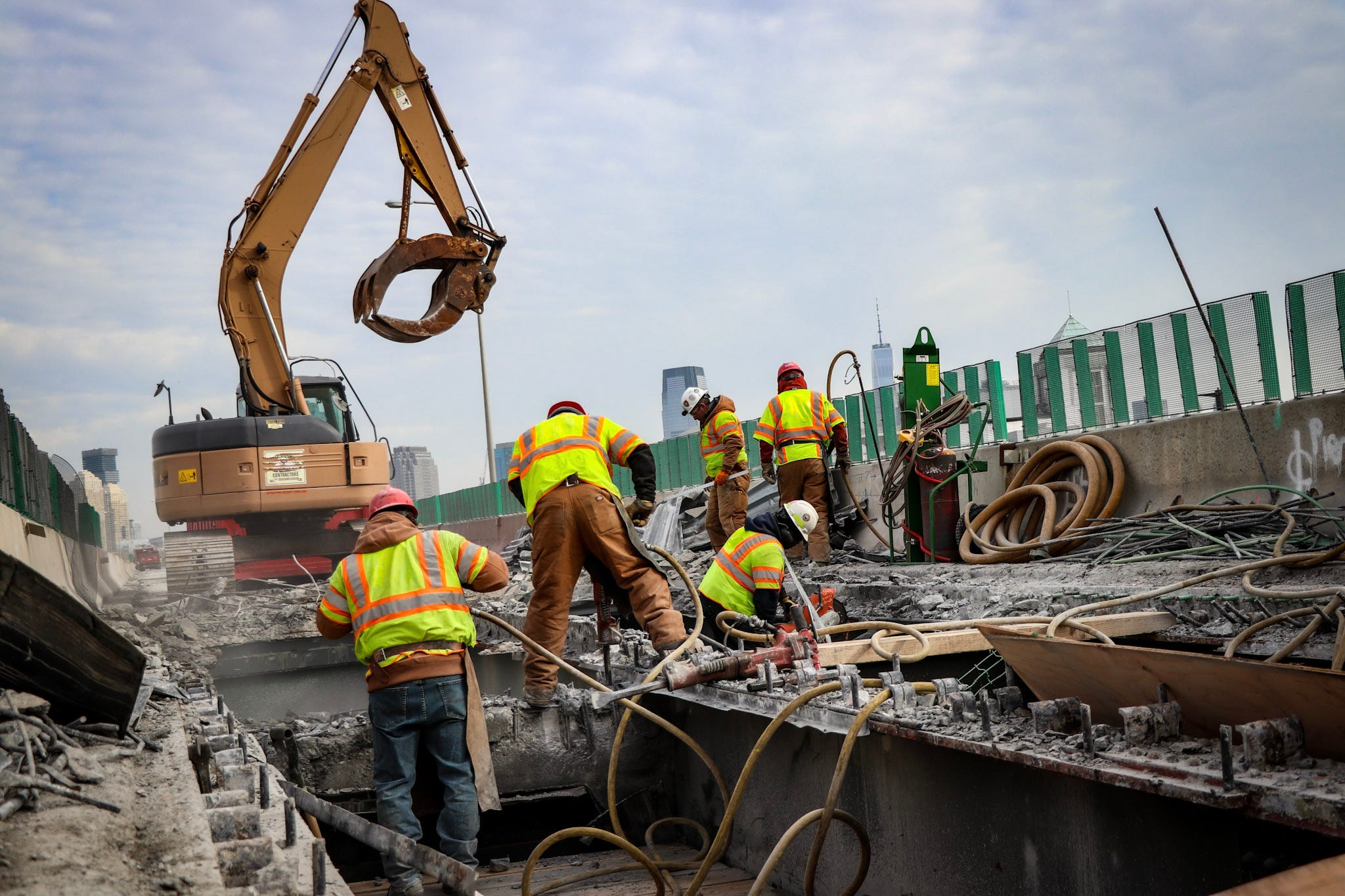
I’ve lost count how many times I’ve submitted cost proposals, fought liquidated damage threats, and negotiated with subcontractors, owners, and GCs. Each negotiation required some kind of common ground where all parties wanted the same thing; the dispute was in how we went about it. When you’re the party with leverage and you want something done, brushing off a proposal is an arrogant move. Negotiations require “rounds.” Each round won’t always be a massive success, but each one is a critical part of the solution when everyone wants a slice of the pie.
At the end of the day, the objective is to build something.
It’s no surprise that the hot topics in the news today are Iran and oil. Markets reacted favorably last week after Donald Trump announced a two-week ceasefire conditioned on Iran reopening the Strait of Hormuz.
Half of the internet’s armchair generals read this as a retreat. The other half called it a win for Iran. Both readings miss what actually happened, because both readings come from people who have never had to negotiate a change order against a hard deadline. The largest infrastructure rebuild the Middle East has seen since the original Aramco buildout in the 1940s is on the table - and that’s worth negotiating.
While everyone else is screaming “Israel” and “Trump chickened out”, I’m looking for signals.
This entire conflict has been an infrastructure war over who controls energy and supply chains. To think otherwise is naive.
Forty days of fighting, and almost every meaningful target on both sides has been a port, a pipeline, a refinery, a substation, an airport, a desalination plant, or a bridge. Each side is fighting over who controls the means of moving energy and people, because whoever controls those things gets to decide what the next forty years of the Middle East look like.
The History
For four decades, Iran ran a four-pronged proxy strategy that made serious capital formation in the Middle East effectively impossible outside the Gulf monarchies.
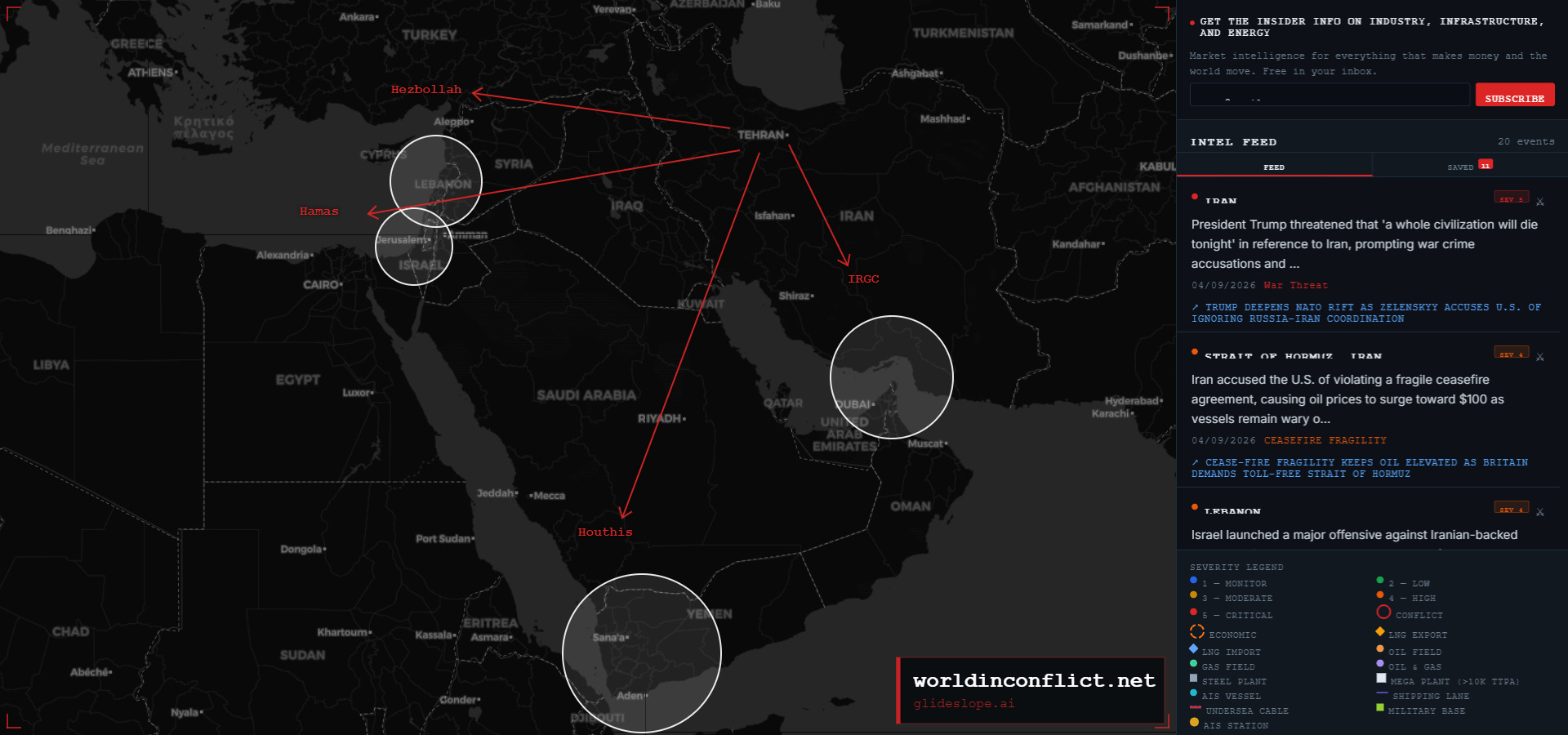
The Houthis sat on the Bab al-Mandab strait at the southern end of the Red Sea and harassed tankers whenever Tehran needed leverage.
Hezbollah turned southern Lebanon into a permanent missile platform aimed at Israel and a permanent veto on Lebanese reconstruction capital.
Hamas kept Gaza as a perpetual flashpoint.
Iranian-aligned militias in Iraq and Syria controlled key corridors and skimmed reconstruction money whenever it tried to flow.
Each one of these proxies was relatively cheap to maintain. Together they accomplished something that would have cost a conventional military hundreds of billions of dollars to achieve: they made the Middle East un-investable for the ports, the desalination plants, the power generation, the rail, the airports, and the petrochemical capacity that a real twenty-first century economy needs. Capital doesn’t deploy at-scale when a proxy militia can turn your ten-billion-dollar terminal into a smoking hole with a ten thousand-dollar drone.
For forty years the math favored leaving the IRGC in place. The Saudi normalization track, the Abraham Accords expansion, and the Yanbu buildout changed that calculus.
The Rebuild
Now comes the part no one in financial media is writing about, because no one in financial media has ever priced a public infrastructure contract.
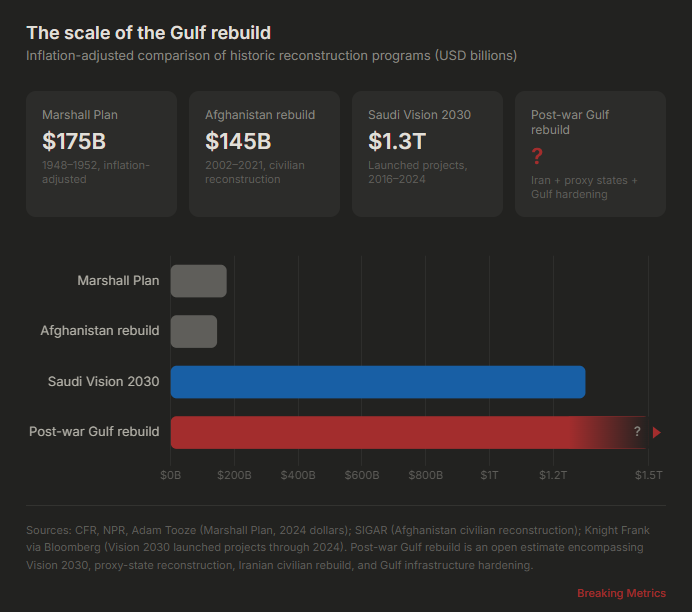
A post-war Middle East needs three things rebuilt simultaneously, and the scale of all three together is something the world hasn’t seen in nearly eighty years.
Iran’s own civilian infrastructure (which has been hollowed out for decades by a uniquely destructive procurement model)
The proxy-damaged states (Lebanon, Syria, Yemen, Gaza, and parts of Iraq where forty years of Iranian-sponsored instability has prevented serious capital from ever taking root)
The offensive infrastructure buildout (Gulf monarchies will need to fund to make sure this never happens to them again: hardened ports, redundant pipelines, expanded refining capacity at Yanbu and elsewhere, new desalination, new power generation, new airports, all of it built to standards that assume the next regional war is a question of when and not if)
The Dead Load
Iran doesn’t have a public infrastructure market in any sense a Western contractor would recognize. The IRGC controls civilian construction through an entity called Khatam al-Anbiya Construction Headquarters, established in 1989 by direct order of Ayatollah Khamenei.
Khatam runs more than 130 mega projects, employs 135,000 people, and operates as the prime contractor on Iran’s oil and gas fields, its dams, its tunnels, its highways, and its metro systems. It built large portions of the Fordow enrichment facility. It is sanctioned by the US, the UN, the EU, the UK, Japan, and Australia. Its commander reports directly to the head of the IRGC, who reports directly to the Supreme Leader.
There’s no owner-contractor relationship, no competitive bid, and no engineer signing a pay app. There is, however, the IRGC deciding what gets built, the IRGC building it, and the IRGC paying itself out of opaque military budgets and oil revenues that nobody else in the Iranian government can audit. The only entity with monitoring authority over Khatam is the IRGC’s own Intelligence Protection Unit. It is, in the most literal sense, a totalitarian general contractor.
The Pie
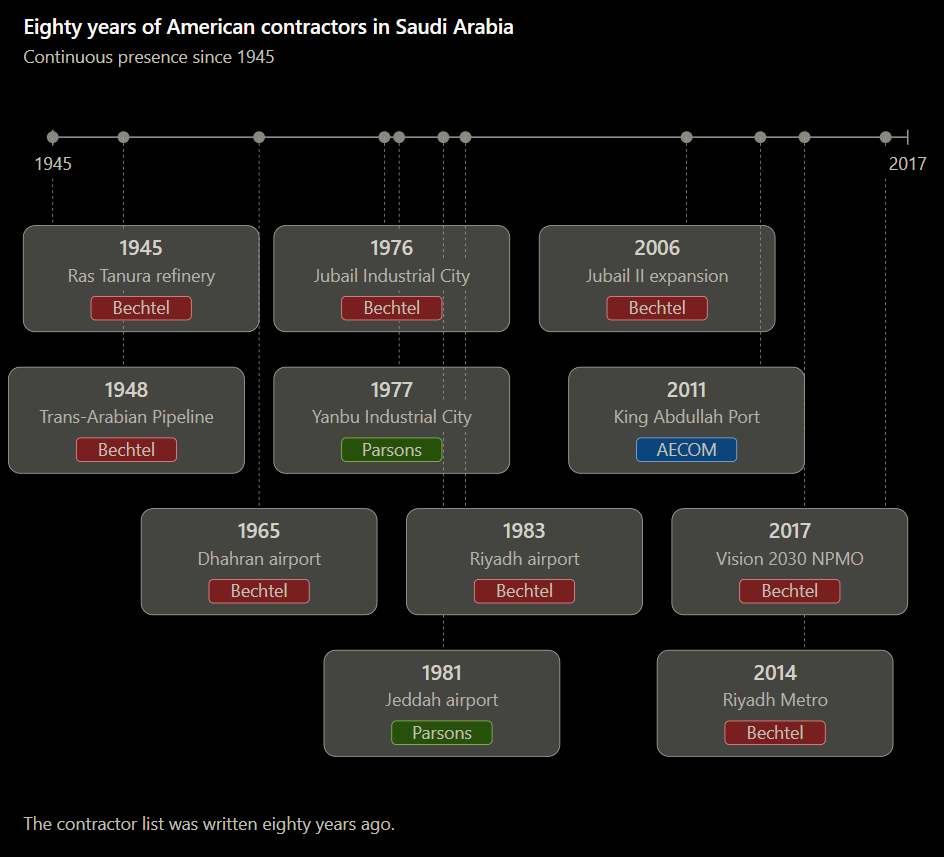
Gulf states are different. There are maybe a dozen companies on the planet that can manage construction at this scale. The American ones (Bechtel, Parsons, Fluor, AECOM, Jacobs, Kiewit on the heavy civil side) have an advantage that nobody else can replicate, because they have been building the Gulf for eighty years already.
Bechtel signed its first contract in Saudi Arabia in 1945, completed the Trans-Arabian Pipeline in 1948, designed the King Khalid airport in Riyadh, and starting in 1976 built Jubail Industrial City from a fishing village into a 1,016-square-kilometer complex that today produces seven percent of Saudi GDP.
Parsons built the King Abdulaziz airport in Jeddah and large portions of Yanbu on the Red Sea - the same Yanbu that became the binding constraint on Saudi oil exports when Iran started targeting the bypass route.
The Royal Commission for Jubail and Yanbu has been Bechtel’s customer continuously since the mid-1970s. Bechtel currently runs Saudi Arabia’s National Project Management Office, which administers a one-trillion-dollar Vision 2030 capital pipeline. The relationship is older than most of the people reading this article.
Winners and Losers
Chinese firms will be locked out of this rebuild for political reasons that should be obvious. Russian firms are gone.
European firms are technically capable but capital-constrained, politically cautious, and lack the heavy civil depth of the American majors. The American EPCMs win this rebuild by default, and they win it at a scale that hasn’t existed since the original Aramco buildout. The Saudis will pay them, the Emiratis will pay them, a post-Hezbollah Lebanon will pay them with reconstruction funds raised from the Gulf, and a post-IRGC Iran will eventually pay them too.
The Close-Out
When the missiles stop, oil still trades in dollars but Iran collects a toll at Hormuz. The IRGC almost certainly still stands inside Iran, which means the revenue from tolls flows back into Khatam al-Anbiya and funds the rebuild.
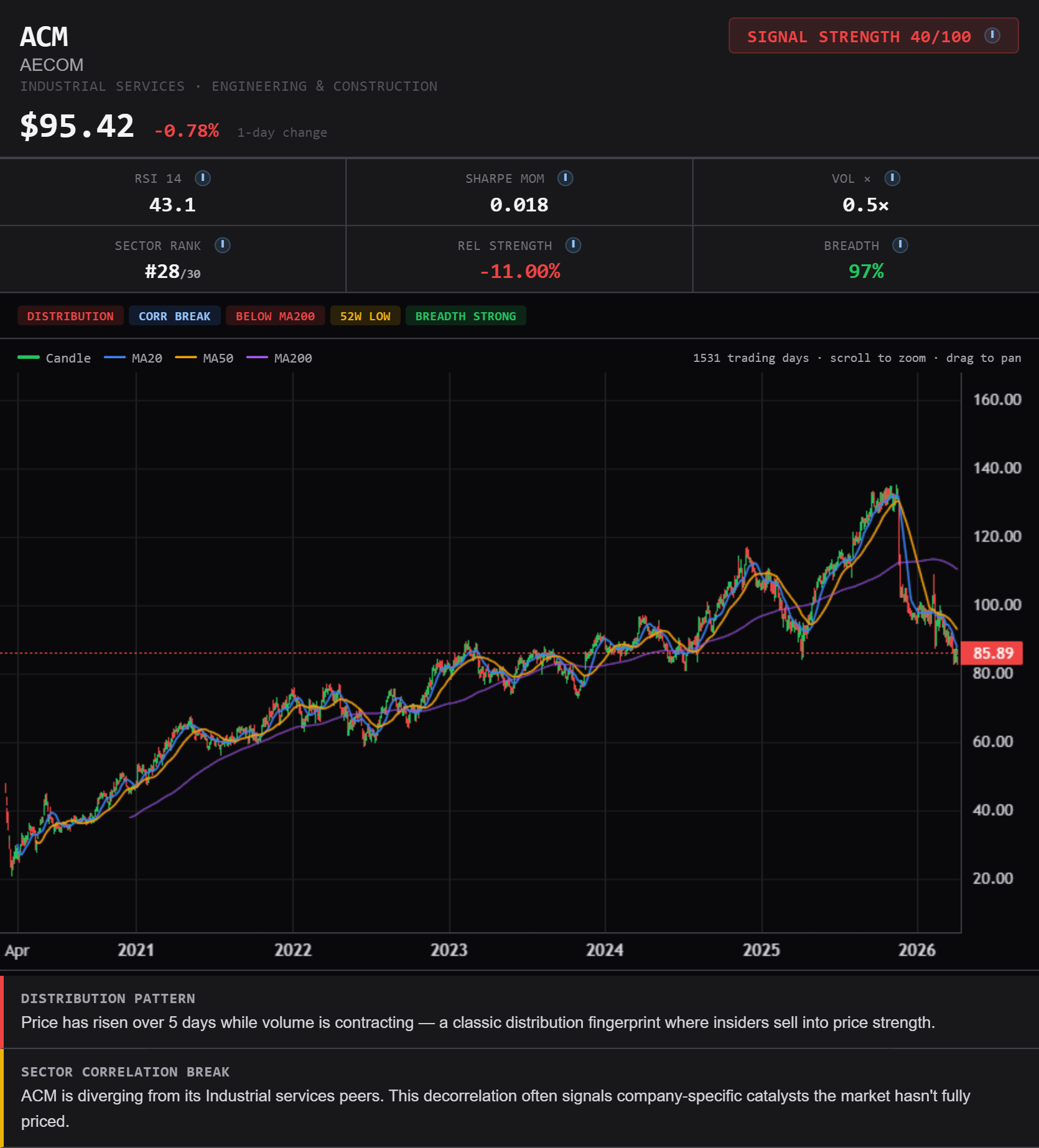
American firms step in to rebuild everything else. If Hezbollah and Hamas are destroyed and the Houthis follow, capital flows that have been frozen for forty years start moving again across the entire region. Bechtel, Parsons, Fluor, and the rest of the American EPCMs collect on the buildout because they are already in the Kingdom holding the relationships that matter - and they’ll each get a slice of the pie when the dust settles.
It all starts with a little negotiation.
Who do you think gets a slice of the pie after the conflict is over and Hormuz reopens? Will Europe even be a part of the conversation?
Sources
Trump-Iran ceasefire and Hormuz toll proposal
NBC News live coverage, April 8, 2026: https://www.nbcnews.com/world/iran/live-blog/live-updates-iran-war-trump-deadline-hormuz-infrastructure-ceasefire-rcna267039
CNBC, “Trump, Iran agree to two-week ceasefire,” April 7, 2026: https://www.cnbc.com/2026/04/07/trump-iran-ceasefire-hormuz-strait.html
CFR, James Lindsay, “Trump Secured a Ceasefire With Iran. Will It Last?”, April 8, 2026: https://www.cfr.org/articles/trump-secured-a-ceasefire-with-iran-will-it-last
Fox News live updates, April 8, 2026: https://www.foxnews.com/live-news/trump-us-iran-war-ceasefire-strait-hormuz-israel-live-updates-04-08-2026
Iran strike on Saudi Aramco Abqaiq facility
CNN live coverage, April 8-9, 2026: https://www.cnn.com/2026/04/08/world/live-news/iran-war-trump-us-ceasefire
Israel strikes on Lebanon, ceasefire carve-out
Same CNN link above covers this
CFR, April 9, 2026: https://www.cfr.org/articles/as-a-strait-of-hormuz-standoff-grows-will-trumps-fragile-iran-ceasefire-hold
Khatam al-Anbiya Construction Headquarters
Wikipedia: https://en.wikipedia.org/wiki/Khatam-al_Anbiya_Construction_Headquarters
IranWire, “The IRGC Commercial and Financial Institutions”: https://iranwire.com/en/features/65741-the-irgc-commercial-and-financial-institutions-khatam-al-anbiya-construction-headquarters/
UN Security Council (via OpenSanctions): https://www.opensanctions.org/entities/NK-jDVU2FLrbrTgX4dXrjA6e5/
Iran Watch entity profile: https://www.iranwatch.org/iranian-entities/khatam-al-anbiya-construction-headquarters-kaa
Radio Zamaneh: https://en.radiozamaneh.com/31851/
JNS, May 2021: https://www.jns.org/the-khatam-al-anbiya-company-and-the-future-of-the-irgc-empire/
Bechtel and Parsons Saudi Arabia history
Bechtel Middle East regional page: https://www.bechtel.com/regions/middle-east/
Bechtel Jubail Industrial City project page: https://www.bechtel.com/projects/jubail-industrial-city/
Time, “The Jubail Superproject,” July 1982: https://time.com/archive/6859438/the-jubail-superproject/
Pampanini, Cities from the Arabian Desert (Google Books): https://books.google.com/books/about/Cities_from_the_Arabian_Desert.html?id=MzVIAAAAMAAJ
BuiltWorlds, “Bechtel charged with managing Saudi Arabia’s infrastructure”: https://builtworlds.com/news/smart-move-bechtel-takes-on-integrating-urban-infrastructure/
Bechtel Riyadh regional HQ opening, 2023: https://www.bechtel.com/press-releases/bechtel-opens-new-regional-headquarters-in-saudi-arabia/